St Mary's Church Carmarthen Eglwys Gatholig Y Santes Fair

Schools

Schools

Catholic Schools have played a fundamental role in the religious and social life of the parish.

John Masters’s School

An Irish colony developed in the late 1840’s at Dan y banc, where ‘there were about fifteen families living in one-roomed cottages, and on the other side of the lane were their stables, where they kept their mules. Each man had to keep a mule, because they used to travel all over the country with crockery of various kinds. In the garden below their houses was another colony of them….. One old man who seemed to feel the utter wretchedness of the children more than any of the others, had put up an old shed, where he tried to gather all the children he possibility could to make them understand something of education and the Roman Catholic faith. This old man went by the name of John Masters… he divided his labour by giving half to gathering rags and bones round the town’.

Mrs Arengo Cross’s School

Mrs Arengo Cross of Abermarlais opened a school for poor children at Carmarthen in 1854. She paid the schoolmaster £10 a year, with free accommodation, with the Rev. Mr. Havard paying £5 a year in addition.

A year later the schoolmaster was receiving £20 a year and a house free of rent, as he had found it impossible to live on less than that. The bishop contributed £5 and Mrs Arengo Cross donated £10 leaving Lewis Havard to find the rest from his scant resources. Later some help was obtained from the Catholic Poor Schools Committee. It was stated that ‘fifty poor children (were) wanting gratuitous education’ . Mrs Cross died in 1861 but the school was still operating in 1863 when Mr Arengo Cross wrote to the Bishop that he had ‘much pleasure in paying the rent of Mr Havard’s School room at Carmarthen as I have always felt for him a sincere regard and esteem and I will continue the payments out of respect for my late dear wife as one of the many good works in which she felt so great an interest.’

St. Mary’s School, Mill Street

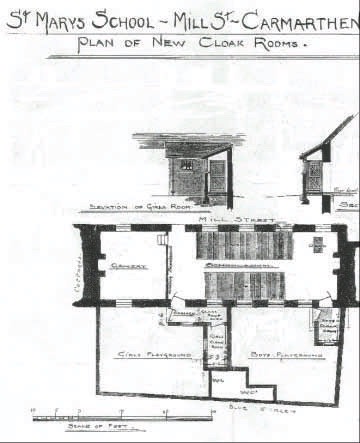
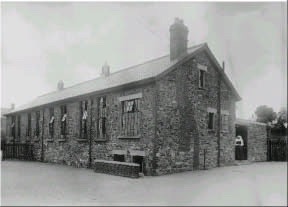
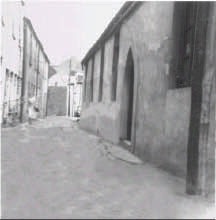
In the late 1860s, a school building was constructed on a site of four or five old houses in Dame Street (later known as Mill Street). The school was 38 ft. long by 18 ft. broad, designed by George Morgan and built by Thomas Williams. It was described as ‘plain, but neat and substantial, lofty, well ventilated in floor and ceiling, efficiently lighted by eight windows, and fitted with desks, gallery etc.’

Mill Street School building
Mill Street School plan

It cost £300 to built, with the greater portion of the funds, according to the local press, was contributed by Dr Brown, Bishop of Newport and Menevia, the remainder being collected by the Rev. W C Williams, the resident priest. The school was financed however, by the sale of the field adjacent to the present cemetery, a field incidentally repurchased in 1908.

Though built for 100, the number of children attending numbered 60, ranging in age from four to nine, ‘under the superintendence of an efficient schoolmistress’. Within a short time attendance reached 90. A figure of note from this period was Miss Ellen Murphy. She taught both in Mill Street School and the new school from 1895 until her retirement in 1941.

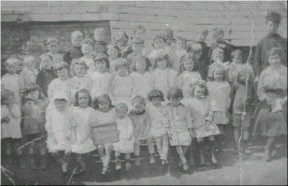
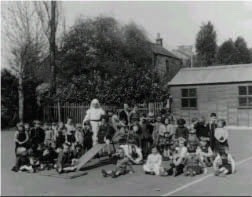
Mill Street School, Infants Class c. 1910

The school grew rapidly in numbers and by 1913 there was an urgent need for further accommodation which was satisfied by converting two cottages at Mill Street into an infants’ classroom.

Over the years the fabric of the school deteriorated to such an extent that baths and buckets were used to catch the rain. In later years Sister Pierre recalled how the nuns would scurry ‘across the playground, half drenched, for more buckets, whilst at the other end of the schoolroom a harassed sister struggled to teach her pupils under the shelter of an umbrella!’

Not surprisingly the Mill Street school was condemned by the Education Authority and a new site chosen near the church. Building plans were postponed by the intervention of the First World War. Soon after the war, Ernest Collier drew up new plans, but by the time they had been revised to less expensive proposals, contracts were not signed for the new school until May 1922.

The Private School , St Winefride’s

In 1904 the Sisters opened a private school, but the number of pupils remained very small. This was probably due to several factors : elemen- tary education for catholic children was already provided by the parish school in Mill Street; very few catholic parents could afford to pay for secondary education for their children, and there was an excellent High School which the protestants attended. Moreover, there was a certain section of the population who viewed the Sisters’ activity as something of a challenge, with the result that the school received little or no patronage.

St Winefride’s Convent School 1904 – 1920

In 1906 there were still no more than 9 pupils in the school so, in an attempt to attract more, “Wauniago”, a property outside the town was bought. The community moved into it in September 1907. The number of pupils diminished because of the distance the pupils had to travel in order to reach the school.

The Sisters then moved from “Wauniago” to No. 29 Picton Terrace until another property better suited to their needs could be acquired. After a comparatively short time the number of pupils began to increase, by the end of the year there were 24. Two years later the Sisters moved to Picton House which, although it was not in a good state of repair, offered definite possibilities for the future.

When Mère Marie Alvarez made the canonical visitation in 1919 she wrote in her report : ” …. the pupils, 84 in the parish school and 44 in the private school, love the Sisters and seem to be very much at home with them…” In July 1919 St Winefride’s Convent school was closed, a casualty of the Fisher Education Act, the requirements of which could not be met with the meagre resources available to the Sisters. To the keen regret of teachers, parents and pupils, the school ceased to exist at the end of the summer term in 1919.

St Mary’s School, Union Street

The new Catholic school premises were erected on the field adjoining St Mary’s Catholic Church. They were formally opened his Grace the Most Rev. Dr Mostyn, Archbishop of Cardiff.

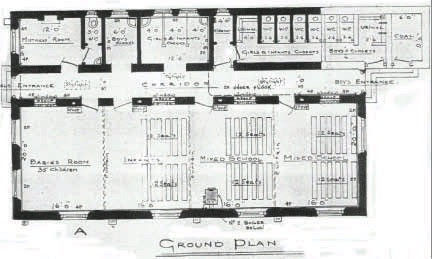
The school comprised four classrooms with a staff room and cloak room. They were small but well lighted and ventilated. A corridor ran the whole length of the building. The playgrounds were small and rough. The staff was entirely female, three being Roman Catholic Sisters.

All were described as ‘exceedingly painstaking and conscientious, and cooperate to produce a high standard of education amongst pupils who are not over-bright. Four of the scholars are the children of Belgian refugees who live in St Clears.’

The school could accommodate 128, and there were 124 scholars on the books.

St. Mary’s School, 1943
Above: St. Mary’s new school plan, 1921
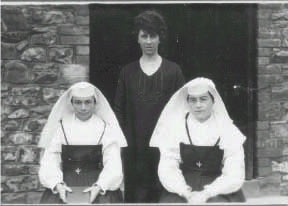
Sr. Pierre (Ma Mère), Miss Ellen Murphy and Sr. Barbara 1921
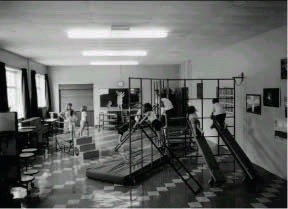
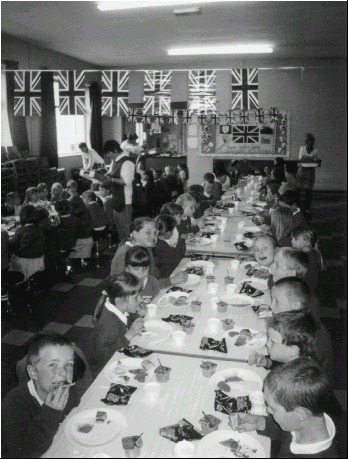
School Dining Hall, 1949

The opening of the new school in 1923 was the start of a new chapter in the life of the parish.

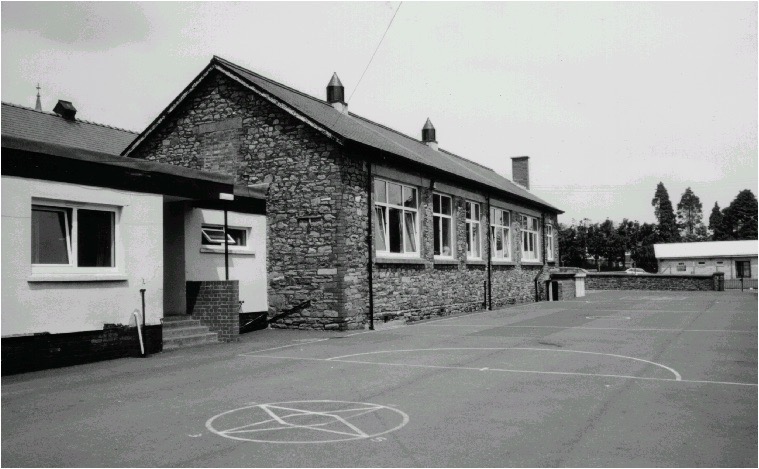
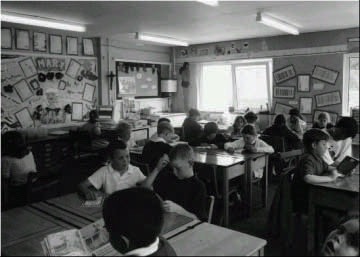
The school has continued to thrive and develop, and as it grew new classrooms and a hall were added.

Some 400 children were evacuated to Carmarthen. Only a dozen of these children were Catholics and most of these were absorbed into St Mary’s Schools. The LCC however, requisitioned St Mary’s Hall and used it as a junior school for some 50 children.

The Headteacher, Mother Pierre (Ma Mère) resigned in 1948 having taught at St Mary’s school for over 40 years. She was followed by Sister Henri. On her retirement in 1955 Sister Henri was replaced by Sister Mary Enda. Sister Mary Andrew was appointed head teacher in July 1959.

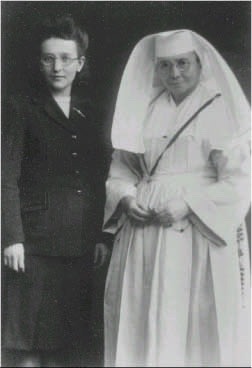
Miss Cecile Bequec and Ma Mère
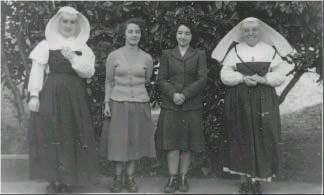
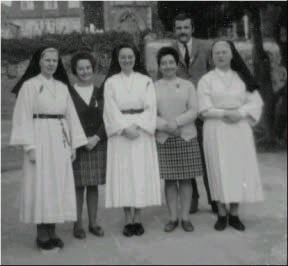
Sr. Mary Enda, Pat Jones, Eileen Jones and Sr. Henri c. 1950
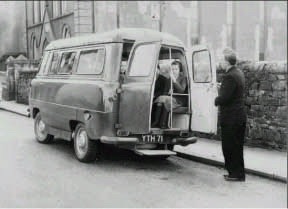
Fr. Flavian with ‘busette’, c. 1961

With the opening of the then Blessed John Lloyd Catholic Secondary Modern School in Llanelli in 1963, St. Mary’s lost its responsibility for the senior pupils.

In 1961, a ‘busette’ was purchased by Fr Flavian to transport Catholic children from outlying districts. Rev Fr Finton acted as chauffeur. Children were picked up from Pendine, Whitland, Laugharne and St. Clear’s. The school bus run came to an end in 1969 when the mini-bus was written off when taking members of the Youth Club home.

In 1966 work began on extending the school, with three new Junior class rooms and the conversion of the four existing classrooms into two Infant classrooms. are The erection of a new staff room Head’s and deputy Head’s rooms was also included in the project.

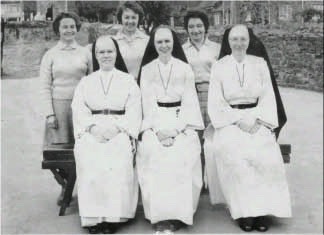
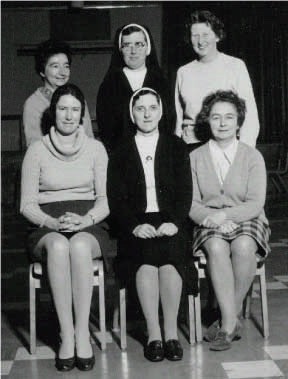
Standing – Pat Jones, Jill Lewis, Eileen Jones Seated – Sisters Michael Francis, Mary Andrew, and Mary Brigit, c. 1963
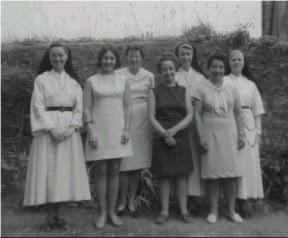
Staff 1969 – Sr. St Mary, Pat Jones, Sr Mary Hilda, Eileen Jones, Patrick Skeets and Sr. Imelda Kelly

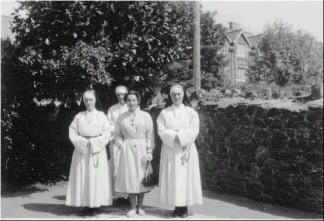
Cross and Passion Sisters. Sister Maire was headteacher, serving the school from 1970 to 1975. The Sisters remained until 1986.

Amongst the teachers who gave many years devoted service to the school were Pat and Eileen Jones. Pat Jones retired in 1981 after 41 years, first as teacher, then as head-mistress, and her sister Eileen in 1983 having spent 33 years at St. Mary’s.

Standing: Eileen Jones, Sr. Marion, Nancy Butters,
Seated: Marilyn Davies, Sr. Maire and Pat Jones, c. 1972

A great debt of gratitude is owed to all those dedicated people who have taught and served the Catholic children of Carmarthen over the years by providing a proper Christian education in a Catholic environment. The Daughters of the Holy Ghost, the Sisters of the Cross and Passion and the lay staff of the school have done much to lay the basis of a successful parish.

NURSERY SCHOOL

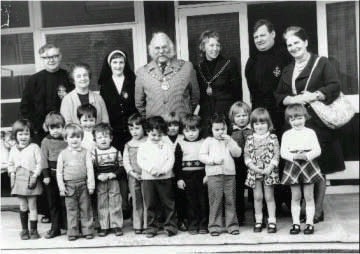
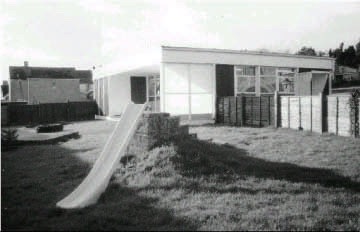
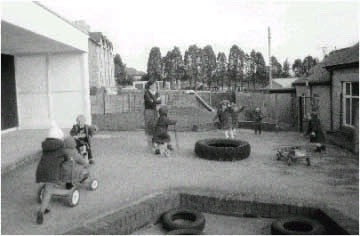
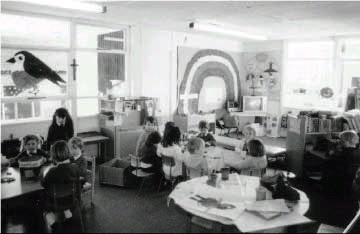
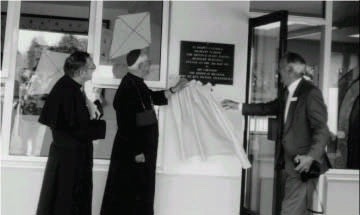
An important addition to the school was the build- ing of a nursery unit in 1975. This provided places for twenty young children. It would be replaced by a new nursery building in 1997.

Nursery Official opening 1975